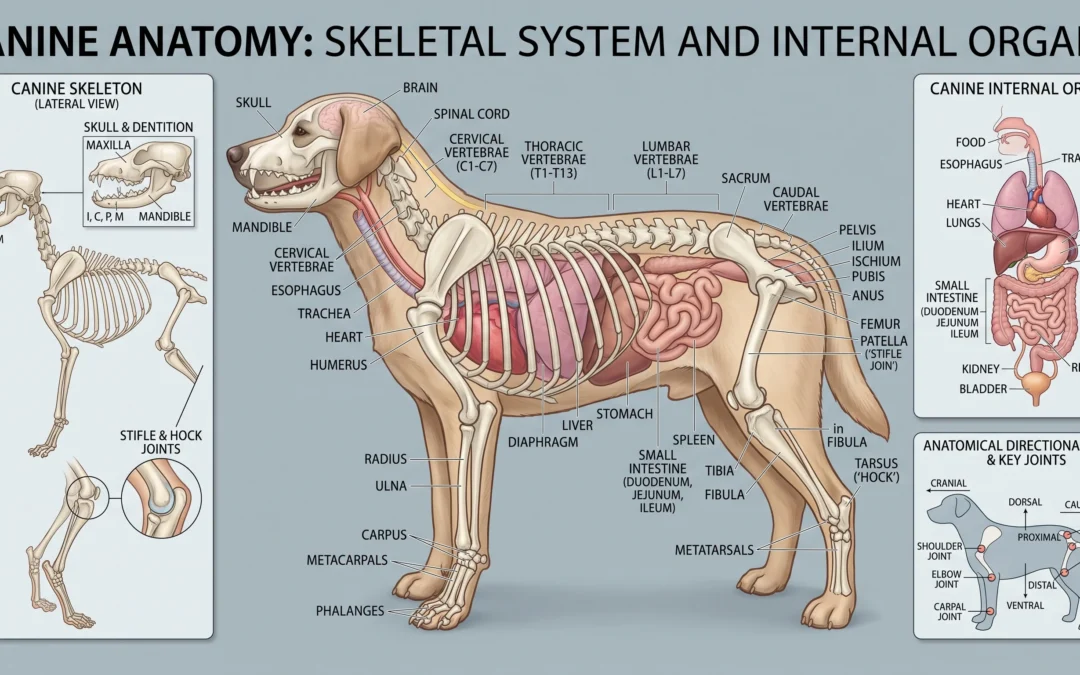
What’s really going on beneath your dog’s fur when they leap onto the couch or sprint across the yard? The anatomy of a dog skeleton is the internal framework of bones and cartilage that supports every movement, protects vital organs, and shapes how your dog grows and ages. Most adult dogs have around 320 bones, split into two main divisions that work together to keep your dog moving safely. Understanding that framework helps you spot injury signs earlier, make sense of breed-specific health risks, and plan the kind of structured, supervised exercise and care, like a good dog daycare, that keeps your dog thriving at every life stage.
Key Takeaways
- A dog’s skeleton holds roughly 320 bones, give or take a few depending on tail length.
- It splits into the axial skeleton (skull, spine, ribs, sternum) and the appendicular skeleton (limbs and girdles).
- Dogs walk on their toes, so the joint that looks like a backward knee is really the hock.
- Skull shape drives real health differences, especially for flat-faced breeds.
- Puppy bones start soft and harden slowly, so growth-stage activity should stay structured and supervised.
What Is the Canine Skeleton?
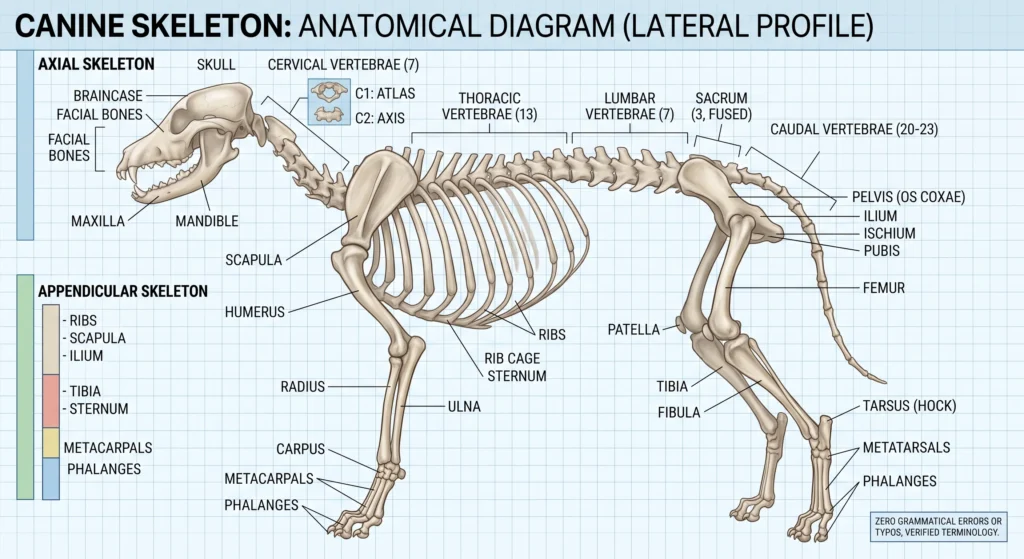
The canine skeleton is the framework of bones and cartilage that gives a dog its shape, supports its weight, protects its organs, and anchors the muscles that create movement. Think of it as the structural frame of a building: everything is built on it, and without it there is no support, protection, or motion.
A dog carries around 320 bones and roughly 700 muscles, a lot of moving parts for one body. They fall into two divisions: the axial skeleton, which forms the central core, and the appendicular skeleton, which covers the limbs and the structures that link them to that core.
Knowing how the dog skeletal system fits together helps you notice when something is off, understand your breed’s risks, and speak to your vet with more confidence when a limp shows up out of nowhere.
How Is the Dog Skeleton Divided?
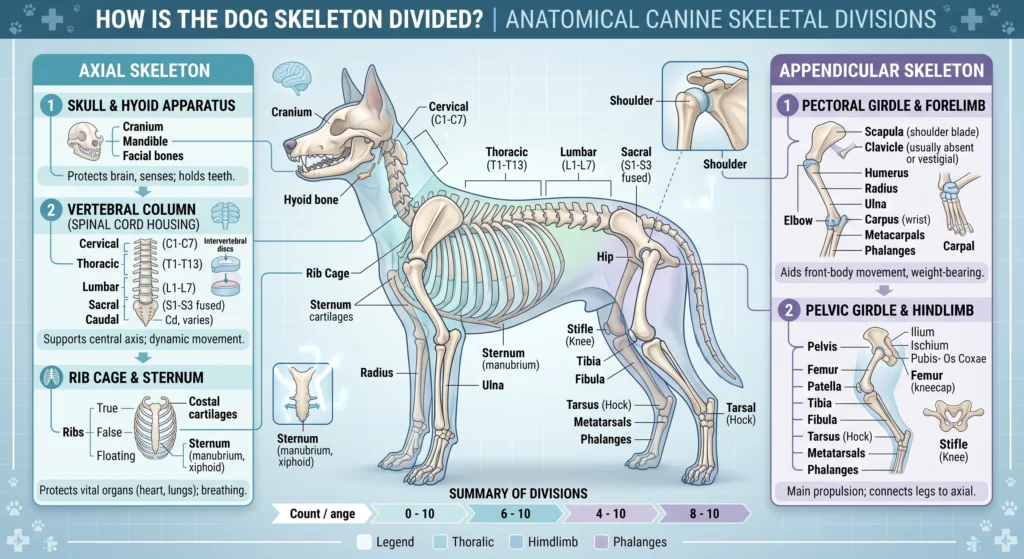
The canine skeletal structure is organised into two main divisions, each with a clear job. The easiest way to hold it in your head: the axial skeleton is the core, the appendicular skeleton is the moving parts. Together, they make up the full skeletal anatomy of dogs, each carrying roughly half the total number of bones. It is the same framework vets use to orient structures on an X-ray, and the quickest way to place where an injury sits.
The Axial Skeleton: The Central Core
The axial skeleton is the central axis of the body: the skull, vertebral column, ribs, and sternum. Most dogs have 13 pairs of ribs that attach to the thoracic vertebrae and curve around to meet the sternum, forming the cage that shields the heart and lungs. The skull protects the brain, and the vertebral column protects the spinal cord while anchoring everything else.
The Appendicular Skeleton: Limbs and Girdles
The appendicular skeleton covers the forelimbs, hindlimbs, and the girdles fastening them to the axial skeleton. The pectoral girdle links the front legs to the body; the pelvic girdle anchors the rear. This is where most movement-related injuries happen, from fractures and ligament tears to developmental joint conditions, since these bones absorb the demands of running and playing.
The Vertebral Column: How Many Vertebrae Do Dogs Have?
Dogs typically have 50 to 53 vertebrae, arranged into five regions. The spine works like a flexible chain of interlocking links, each cushioned by discs, guarding the spinal cord while letting a dog twist, flex, and stretch through a surprising range.
Each region has a specific job:
| Region | Vertebrae | Role |
| Cervical | 7 | Move the head and neck |
| Thoracic | 13 | Anchor the rib cage; stiffest section of the spine |
| Lumbar | 7 | Drive the powerful rear-end push when a dog runs |
| Sacral | 3 (fused) | Anchor the pelvis |
| Caudal | 20 to 23 | Shape and move the tail |
Tail length is the main reason counts vary between dogs. A long tail means more caudal vertebrae than a natural bobtail, which is why the total sits at “around 320” rather than a fixed figure. Bigger dogs feel this most, since larger frames load the spine and joints more over a lifetime, one reason the structured activity behind the real benefits of supervised daycare pays off as they age.
Dog Forelimb and Hindlimb Skeleton Explained
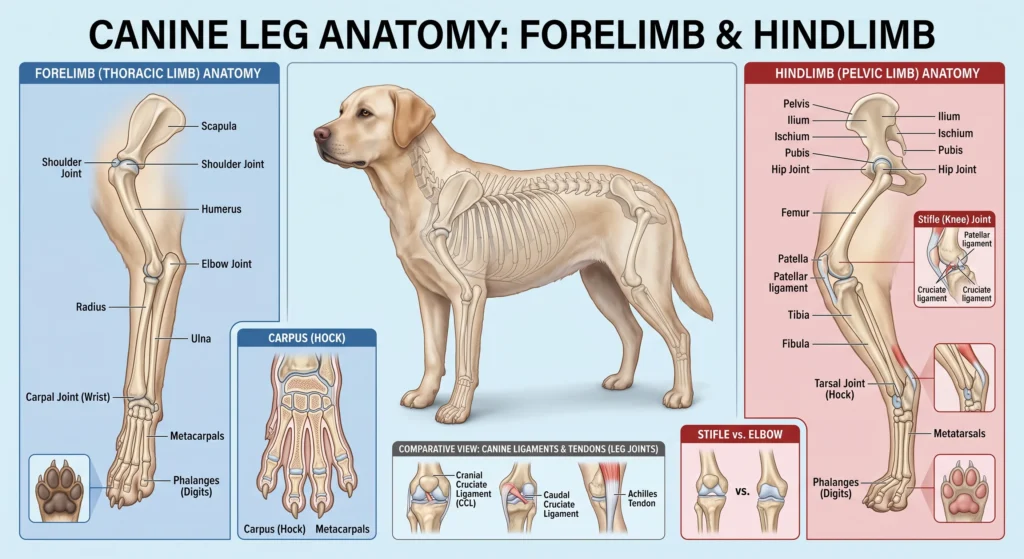
The limb bones of the appendicular skeleton are where a dog’s athleticism lives, and how they are laid out explains both how dogs move and where they break down.
Here is the fact that surprises most owners: dogs are digitigrade, walking on their toes rather than the flat of the foot the way we do. That is why a dog’s “knee” looks like it bends the wrong way. What you are seeing is the hock, the equivalent of a human ankle. The true stifle, or knee, sits higher up the leg, closer to the body.
The Dog Forelimb Skeleton: Shoulder to Paw
The dog forelimb skeleton runs from the scapula, or shoulder blade, through the humerus, then the radius and ulna of the forearm, the carpal bones that act as the wrist, and finally the metacarpals and phalanges of the toes. One detail matters: dogs have no functional clavicle. In people, the collarbone braces the shoulder, but in dogs its absence lets the shoulder blade rotate freely, lengthening the stride and helping them cover ground so efficiently at speed.
The Dog Hindlimb Skeleton: Hip to Paw
The dog hindlimb skeleton starts at the pelvis, built from three fused bones: the ilium, ischium, and pubis. The femur runs down to the stifle, where the patella sits, and below it the tibia and fibula carry the load to the tarsal bones of the hock, then the metatarsals and phalanges. The patella rides in a groove on the femur to guide the joint. When that groove is too shallow, or the alignment is off, you get a luxating patella, a common orthopaedic issue in small breeds.
The Skull and Facial Bone Structure of Dogs
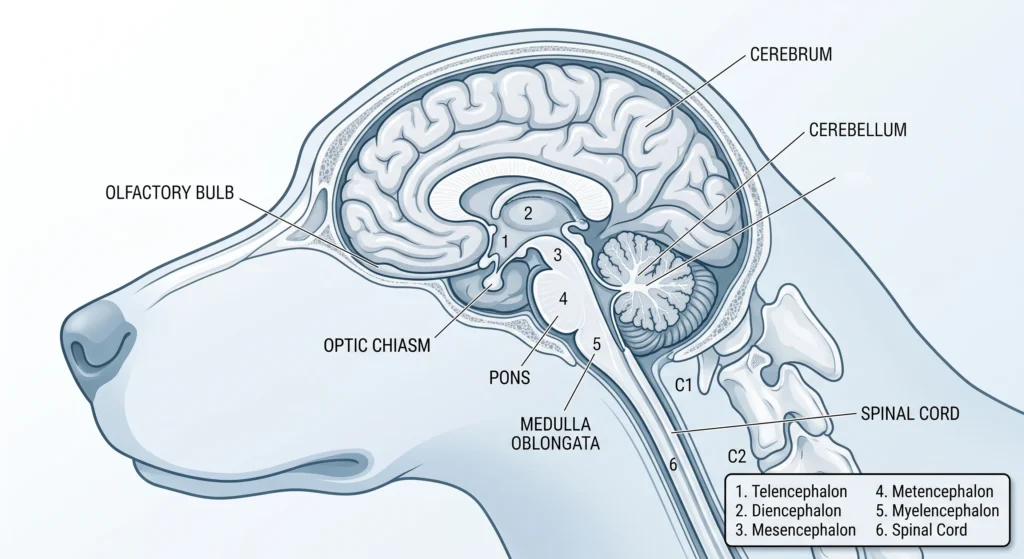
A dog’s skull has two parts: the cranium, which encases the brain, and the facial skeleton, which includes the mandible, nasal bones, and the zygomatic arch, or cheekbones. The mandible is worth noting because it is the only skull bone that actually moves. Everything else is fixed. Skull shape is where breeding has left its most visible mark, in three recognised types.
The Three Skull Shapes
| Skull type | Shape | Example breeds |
| Dolichocephalic | Long, narrow skull with an extended muzzle | Greyhounds, Collies |
| Mesocephalic | Balanced, medium proportions (the baseline) | Labrador Retrievers, Beagles |
| Brachycephalic | Short, compressed, flat face | Bulldogs, Pugs, French Bulldogs |
Why Skull Shape Affects Health
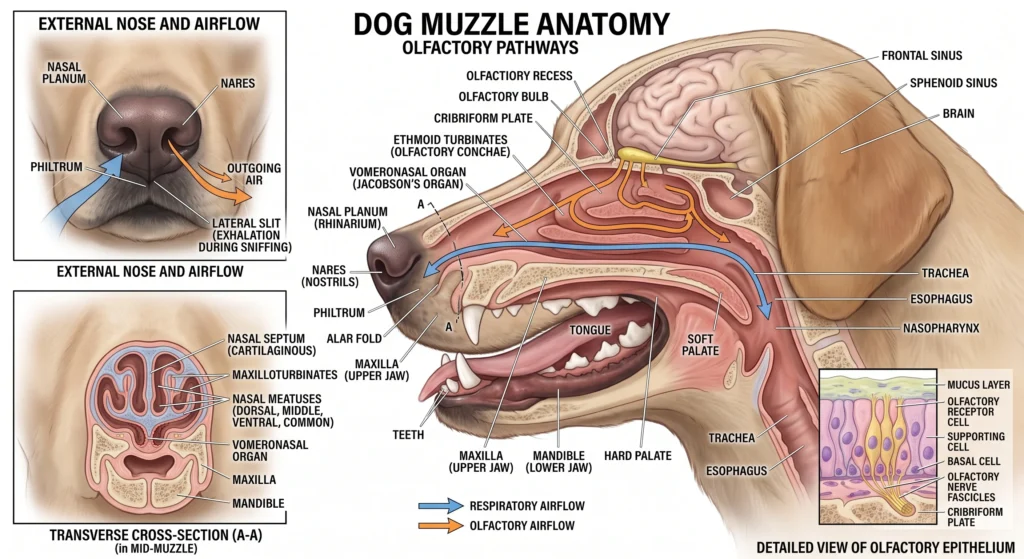
The consequences are real. Brachycephalic breeds carry the same number of teeth as any dog, but those teeth must fit a much shorter jaw, leading to crowding, misalignment, and dental disease. Their compressed nasal passages also restrict airflow, so flat-faced dogs are more prone to breathing trouble in heat or hard exercise. Because so much of this traces back to bone structure, keeping the folds and muzzle of flat-faced breeds clean and comfortable is a genuine part of routine, low-stress grooming, not just a cosmetic nicety.
How the Dog Skeleton Changes as Puppies Grow

Puppies aren’t born with fully formed bones. They start with a skeleton made largely of flexible cartilage, which hardens into bone through a process called ossification.
From Cartilage to Bone: The Ossification Process
The last areas to ossify are the growth plates, cartilaginous zones found at the ends of the long bones in the limbs. Because these areas are still soft and actively changing, they’re also the most vulnerable to injury from high-impact or repetitive stress. This is exactly why high-impact jumping and heavy repetitive exercise are generally discouraged for puppies: an injury to an open growth plate can affect bone development in ways that cause long-term joint problems. Growth plates close at different ages depending on breed size, which is a big part of why larger breeds take so much longer to reach full skeletal maturity than smaller ones do.
Nutrition’s Role in Healthy Bone Development
Nutrition plays an equally important role. Calcium, phosphorus, and vitamin D all directly support healthy bone formation. Imbalances, particularly over-supplementing calcium in large-breed puppies, can interfere with normal ossification and contribute to developmental orthopaedic disease. Large, active breeds like Huskies have strong skeletal builds designed for endurance, but their longer skeletal maturity timeline means their exercise needs to be structured and supervised rather than left to chance during the growth period, which is exactly the kind of oversight a good dog daycare in Vancouver provides through consistent, handler-led activity matched to a dog’s stage of development.
Why Your Dog’s Skeletal Health Matters Day to Day
Understanding how your dog’s skeleton works is genuinely useful for everyday dog owners, not just veterinary professionals. Most dog parents make daily decisions about exercise, diet, and activity without a clear picture of what’s happening structurally inside their dog’s body.
This kind of awareness helps in three practical ways:
- Spotting warning signs early. Limping after play, reluctance to use stairs, swollen joints, or a visible change in gait can all point to skeletal or joint issues that warrant a vet visit sooner rather than later.
- Understanding breed-specific risks. Hip dysplasia in large breeds, luxating patella in small breeds, and breathing complications in brachycephalic breeds are all rooted in skeletal structure, an area where ongoing veterinary research into genetic predisposition and joint health across specific breeds continues to shape how these conditions are understood.
- Making better decisions about exercise timing. This matters most for growing puppies whose growth plates aren’t yet closed, but it applies year-round. Cold weather can stiffen joints and change how a dog moves, which is why knowing when the temperature gets genuinely risky for a walk matters as much in January as in July.
All DogPlay handlers complete Canine First Aid training as part of the certifications every team member holds before working with dogs, and that training includes musculoskeletal awareness: recognizing signs of strain, discomfort, or injury so dogs in their care are always watched by someone who knows what to look for. Every care decision, from choosing the right exercise to scheduling vet check-ups, benefits from a clearer picture of how your dog is built.
A Stronger Foundation for Your Dog’s Everyday Life
Understanding your dog’s skeleton is more than a biology lesson. It’s a practical foundation for recognising how your dog moves, grows, and stays healthy over a lifetime. From the flexible chain of the vertebral column to the digitigrade mechanics of the limbs and the breed-specific implications of skull shape, every part of that framework tells a story about how your dog is built to live. The more familiar you are with that structure, the better equipped you’ll be to recognise problems early, choose activities that suit your dog’s age and breed, and give them the care they deserve. If you want that same attentiveness built into your dog’s daily routine, booking a trial daycare day at DogPlay is a great place to start.
FAQs About Anatomy of a Dog Skeleton
How many bones does a dog have?
Most adult dogs have around 320 bones, though the exact number shifts with tail length since the tail is made of individual caudal vertebrae.
What are the two main parts of a dog’s skeleton?
The axial skeleton (skull, spine, ribs, and sternum) and the appendicular skeleton (the limbs and the girdles that connect them to the body).
Why does a dog’s back leg look like it bends backward?
That joint is the hock, the equivalent of a human ankle, not the knee. Dogs walk on their toes, so the true knee sits higher up and closer to the body.